
Result:
What is a Directional Derivative?
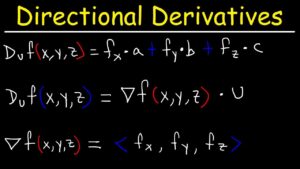
A directional derivative measures the rate of change of a multivariable function in any chosen direction. Unlike partial derivatives that calculate change along the x-, y-, or z-axis, the directional derivative tells you how fast a function is changing along a specific vector.
In simple terms:
➡️ It shows how steep the function is in the direction you want.
➡️ It is widely used in multivariable calculus, gradient analysis, optimization, machine learning, engineering, and vector calculus.
Our Directional Derivative Calculator helps students, teachers, engineers, and researchers compute this value instantly without manual calculations.
For more advanced mathematical tools and technical computation resources, visit our dedicated mathematics section.
✅ Directional Derivative Calculator – Features
✔ Easy to use online tool
✔ Supports any function of x, y, z
✔ Computes gradient components using numerical differentiation
✔ Automatically normalizes the direction vector
✔ Provides step-by-step result:
-
Gradient vector
-
Unit vector
- Final directional derivative
You can also go through – Standard Deviation Casio Calculator
⭐ How to Use the Directional Derivative Calculator
Follow these simple steps:
1. Enter the function f(x, y, z)
Examples you can input:
-
x*y + z^2 -
sin(x) + cos(y) -
x^2 + y^2 + z^2 -
e^(x*y)
Make sure to use standard mathematical syntax.
2. Enter the point (x₀, y₀, z₀)
This is the point where you want the directional derivative.
Example:
x₀ = 1, y₀ = 2, z₀ = 0
3. Enter the direction vector (a, b, c)
This is the direction in which the rate of change should be calculated.
Example:
a = 3, b = 4, c = 1
The calculator automatically converts this into a unit vector.
4. Click “Calculate”
The calculator instantly displays:
-
Gradient ∇f
-
Normalized unit vector
-
Directional derivative value
⭐ How the Directional Derivative Calculator Works
Our calculator uses the mathematical formula:
Dᵤf = ∇f · u
Where:
-
∇f = gradient vector
-
u = unit vector in the direction of (a, b, c)
Step-by-step process:
1. Computes partial derivatives numerically
Using the central difference formula:
Similarly for y and z.
This gives the gradient vector:
∇f = (fₓ, fᵧ, f𝑧)
2. Normalizes the direction vector
u = (a, b, c) / √(a² + b² + c²)
3. Computes the directional derivative
The dot product gives the result:
Directional Derivative = fₓuₓ + fᵧuᵧ + f𝑧u𝑧
This provides the rate of change along the chosen direction.
⭐ Why Use This Directional Derivative Calculator?
✔ Fast & Accurate
Instant numerical results without doing long partial derivative calculations manually.
✔ Supports Any Function
Works with polynomials, trigonometric functions, exponentials, logarithms, and more.
✔ Ideal for Students & Teachers
Perfect for studying multivariable calculus, vector calculus, and advanced mathematics.
✔ Useful for Engineering & Data Science
Directional derivatives are essential in:
-
Machine learning optimization
-
Gradient descent methods
-
Physics simulations
-
3D modeling
-
Surface analysis
✔ Free Online Tool
No signup, no login — compute instantly on any device.
❓ Frequently Asked Questions (FAQ)
1. What is a directional derivative?
A directional derivative measures how fast a function changes in a given direction. It generalizes the idea of slope to higher dimensions.
2. What does the calculator compute?
It computes:
-
Partial derivatives (via central difference)
-
Gradient vector
-
Unit vector
-
The directional derivative value
3. Can I use functions with trigonometric or exponential terms?
Yes, you can enter expressions like:
-
sin(x*y) -
e^(x+z) -
log(x^2 + y^2)
4. Do I need to enter a unit vector?
No.
The calculator automatically normalizes any direction vector you enter.
5. Does the calculator work for 2-variable functions?
Yes — just ignore z and use:
f(x, y)
Example: x^2 + y^2
Set z and c to 0 if not needed.