
Result:
What Is a Simpson’s Rule Calculator?
A Simpson’s Rule Calculator is an online numerical integration tool that helps you approximate the value of a definite integral using Simpson’s 1/3 Rule. This method is widely used in mathematics, engineering, physics, and numerical analysis to estimate the area under a curve when an exact analytical solution is difficult or impossible to compute.
Instead of manually performing repetitive calculations, this calculator automatically applies the Simpson’s Rule formula to give you an accurate approximation of:
-
Definite integrals
-
Area under a curve
-
Motion, velocity, and work calculations
-
Statistical probability distributions
-
Engineering and scientific integrals
It is one of the most reliable and precise methods for numerical integration because it uses quadratic polynomials (parabolic arcs) to estimate the curve.
For more numerical tools, integration methods, and math-based utilities, explore our full collection of advanced calculation resources in the Maths & Science section.
How to Use the Simpson’s Rule Calculator
Using this tool is simple and requires just four inputs:
Step 1: Enter the Function f(x)
Type the mathematical expression you want to integrate.
Examples:
-
x*x + 2*x + 1 -
sin(x) -
Math.log(x) -
e**(-x)(use Math.exp(-x) if needed)
Step 2: Enter the Lower Limit (a)
This is the starting point of the integral.
Step 3: Enter the Upper Limit (b)
This is the ending point of the integral.
Step 4: Enter the Number of Intervals (n)
-
Must be an even number
-
Higher n = higher accuracy
Step 5: Click “Calculate Integral”
The calculator will instantly apply Simpson’s Rule and display the approximate integral value.
You can also go through - Directional Derivative Calculator
How Simpson’s Rule Works (Simple Explanation)
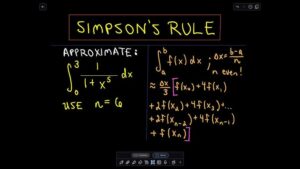
Simpson’s Rule approximates an integral by dividing the interval [a,b][a, b] into evenly spaced segments and fitting parabolic curves between points.
Formula
∫abf(x) dx≈h3[f(x0)+4f(x1)+2f(x2)+⋯+4f(xn−1)+f(xn)]\int_a^b f(x)\,dx \approx \frac{h}{3}\big[f(x_0) + 4f(x_1) + 2f(x_2) + \dots + 4f(x_{n-1}) + f(x_n)\big]
Where:
-
h=b−anh = \frac{b – a}{n}
-
x0=ax_0 = a
-
xn=bx_n = b
-
n must be even
-
Odd indices get coefficient 4
-
Even indices get coefficient 2
Why Simpson’s Rule Is Accurate
Simpson’s Rule is more precise than the Trapezoidal Rule because it uses quadratic (parabolic) interpolation instead of straight-line segments.
It works exceptionally well for smooth, continuous functions.
Why Use This Simpson’s Rule Calculator?
1. Instant Numerical Integration
No manual calculations — get accurate results in seconds.
2. Supports a Wide Range of Functions
You can enter algebraic, trigonometric, logarithmic, and exponential functions easily.
3. Highly Accurate Results
Using an even number of intervals, the calculator applies true Simpson integration for accurate approximation.
4. Useful for Students, Teachers, Engineers, and Researchers
Perfect for:
-
Calculus homework
-
Numerical analysis assignments
-
Engineering simulations
-
Physics integrations
-
Scientific data modelling
5. Ireland-Specific Site Performance
Since this tool runs on CalcIreland.com, it is:
-
Fast
-
Mobile-friendly
-
Designed for students and professionals across Ireland
Frequently Asked Questions (FAQ)
1. What is Simpson’s Rule used for?
Simpson’s Rule is used to approximate definite integrals when exact integration is difficult or when the function cannot be integrated analytically.
2. Why must the number of intervals (n) be even?
Simpson’s Rule works by pairing intervals to form parabolic segments. An even number of intervals ensures each pair forms a complete parabola.
3. Is Simpson’s Rule more accurate than the Trapezoidal Rule?
Yes. Simpson’s Rule generally provides better accuracy because it uses parabolic interpolation rather than linear segments.
4. Can I use trigonometric and exponential functions?
Absolutely. The calculator supports:
-
sin(x), cos(x), tan(x)
-
log(x), ln(x)
-
exp(x), e^(x)
-
Polynomial functions
5. What happens if I enter an odd number for n?
The calculator will show an error because Simpson’s Rule requires an even number of intervals.