
Calculate the concentration of an unknown solution using titration data.
⭐ Titration Calculator – Free Online Chemistry & Molarity Calculator (Ireland)
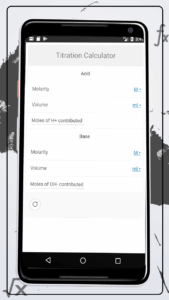
Welcome to our Titration Calculator, your fast, accurate, and easy-to-use tool for calculating unknown concentration, volume, or moles during any titration experiment. Designed for students, teachers, laboratory technicians, and chemistry learners in Ireland, this titration solver helps you perform calculations instantly without manual formulas or errors.
Whether you’re analysing an acid–base titration, redox titration, precipitation reaction, or complexometric titration, this calculator gives reliable results based on standard titration equations and stoichiometry.
For more scientific and chemistry-based tools, explore our Science & Maths Calculators section.
🔍 What Is a Titration Calculator?
A Titration Calculator is an online chemistry tool that helps you determine the unknown concentration, moles, or required volume of a solution during a titration experiment.
In chemistry, titration involves adding a solution of known concentration (titrant) to a solution of unknown concentration (analyte) until the reaction reaches the equivalence point.
This calculator automates all titration calculations, including:
-
Molarity (M)
-
Volume (L)
-
Moles (mol)
-
Stoichiometric mole ratio (a:b)
Instead of calculating manually, this tool solves everything instantly using the standard titration formula:
C1V1⋅ba=C2V2C_1V_1 \cdot \frac{b}{a} = C_2V_2
🧪 How to Use the Titration Calculator
Using the calculator is simple. Just follow these steps:
Step 1: Choose what you want to calculate
-
Unknown concentration
-
Unknown volume
-
Moles of the unknown
Step 2: Enter the titrant details
-
Titrant concentration (M)
-
Titrant volume (L)
Step 3: Enter the analyte (unknown solution) details
-
Unknown volume (L) (only if calculating concentration)
Step 4: Enter the stoichiometric mole ratio (a : b)
-
‘a’ = moles of titrant
-
‘b’ = moles of analyte
This supports acid–base, redox, and complexometric titrations.
Step 5: Click “Calculate”
Your result will appear instantly as:
-
Concentration in molarity (M)
-
Required volume in litres (L)
-
Moles of unknown solution
Perfect for lab reports, homework, revision, and research.
You can also go through - Binomial Expansion Calculator
⚙️ How the Titration Calculator Works
The calculator uses the fundamental titration equation:
C1V1=C2V2⋅abC_1V_1 = C_2V_2 \cdot \frac{a}{b}
Where:
-
C₁ = concentration of titrant
-
V₁ = volume of titrant
-
C₂ = concentration of analyte (unknown)
-
V₂ = volume of analyte
-
a:b = stoichiometric mole ratio
✔️ Example
If you titrate 0.1 M NaOH with 25 mL HCl, the calculator will instantly compute the unknown concentration of HCl using the balanced reaction.
This eliminates manual calculations, reduces errors, and ensures accurate results for any chemistry experiment.
⭐ Why Use This Online Titration Calculator?
✔️ Fast & Accurate
Instant calculation using precise titration formulas.
✔️ Supports All Types of Titrations
-
Acid–base titration
-
Redox titration
-
EDTA / complexometric titration
-
Precipitation titration
✔️ Includes Mole Ratios (a:b)
Easily calculate reactions that are not 1:1.
✔️ Ideal for Students & Lab Use in Ireland
Suitable for Junior Cert, Leaving Cert Chemistry, university labs, and research work.
✔️ No sign-up or downloads required
Completely free to use on any device.
✔️ Perfect for reports & assignments
Get accurate molarity and titration results instantly.
❓ Frequently Asked Questions (FAQ)
1. What is titration in chemistry?
Titration is a laboratory method used to determine the unknown concentration of a solution by reacting it with a solution of known concentration (titrant).
2. What does this titration calculator do?
It calculates unknown concentration, moles, or volume based on titrant values and stoichiometry. It works for all titration types.
3. What units does the calculator support?
The calculator uses chemistry-standard units:
-
Molarity (M)
-
Litres (L)
-
Moles (mol)
You can convert mL → L easily (1 mL = 0.001 L).
4. What are a and b in titration calculations?
They represent the stoichiometric mole ratio from the balanced chemical equation.
Example:
In H2SO4+2NaOHH_2SO_4 + 2NaOH:
a = 2 (NaOH)
b = 1 (H₂SO₄)
5. Is the titration calculator accurate?
Yes. It uses the standard titration equation and stoichiometric ratios used in all chemistry textbooks and laboratory manuals.